
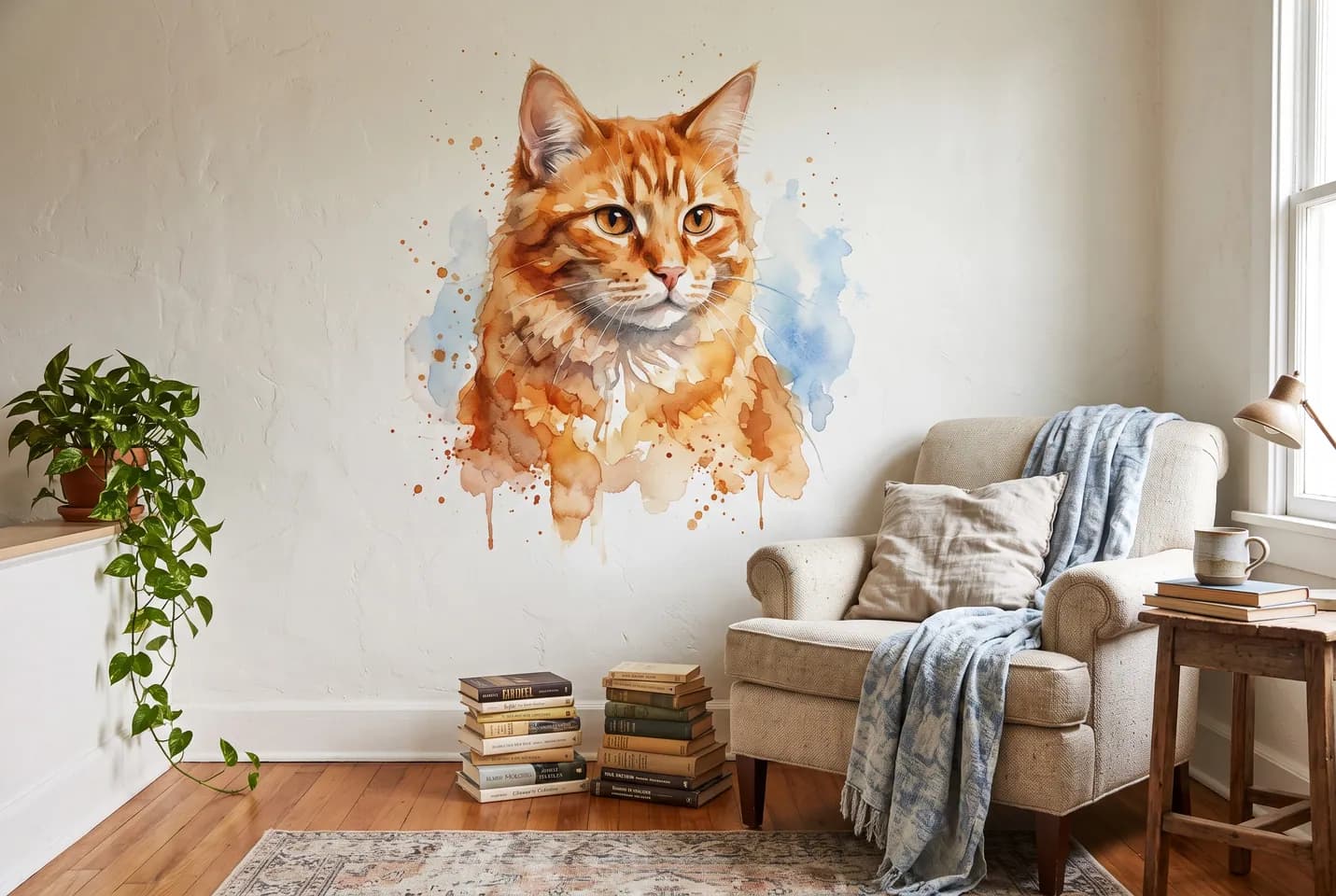
An AI pet portrait prompt works best when you describe the features you would recognize at a glance, then name the style and setting. Include coat color and markings, ears, eyes, pose, and mood. A text prompt guides a new interpretation; it cannot promise an exact likeness. CanvasGenie also lets you upload a pet photo as a visual reference for a painted interpretation.
What details should I put in a pet portrait prompt?
Start with the pet, then describe its distinctive features and the portrait you want. Concrete words such as “white blaze down the nose” give clearer direction than “cute dog.”
| Detail | Why it helps | Example words |
|---|---|---|
| Animal and build | Sets the subject's basic shape | Small, sturdy terrier; long-bodied orange cat |
| Coat | Describes color and texture | Short black coat; fluffy cream fur |
| Markings | Separates your pet from a generic one | White chest, tan eyebrows, dark muzzle |
| Ears and face | Adds recognizable shape | One ear folded; round face; narrow muzzle |
| Eyes and expression | Sets the portrait's character | Amber eyes, curious look; sleepy half-closed eyes |
| Pose | Gives the image a clear composition | Sitting upright; curled on a cushion; looking over one shoulder |
| Mood and style | Directs the artistic treatment | Regal oil painting; playful pop art; quiet watercolor |
| Setting and palette | Places the subject and controls color | Deep green studio backdrop; cream flowers and soft pink |
For cats, color and pattern are separate details: a brown tabby, for example, describes more than “brown cat.” The Cat Fanciers' Association explains common cat coat colors and patterns. For dogs, the American Kennel Club's official Sporting Group breed standards describe features such as coat, ears, eyes, and expression. The Golden Retriever standard is on page 32. You do not need to know a formal breed name; describe what you see.
Google's image prompting guidance also recommends naming the subject, details, and intended scene. For a pet portrait, that means specific features first, then the art direction.
What are some AI pet portrait prompts to try?
Use these as starting points. Replace the bracketed details with your pet's features, and change the style or background to fit your taste.
- Soft watercolor dog: “A gentle watercolor portrait of a [small white terrier] with [a tan patch over the left eye], sitting upright and looking curious, pale blue wash behind the dog, loose brush edges, face clearly visible.”
- Classic oil portrait: “A dignified oil-painted portrait of a [golden retriever] with a [wavy honey-colored coat and soft ears], seated facing forward, warm dark green backdrop, gentle light on the face.”
- Playful pop art: “A bold pop-art portrait of a [black-and-white Boston terrier] with [a white muzzle and upright ears], head turned slightly, bright coral and turquoise blocks, clean graphic shapes.”
- Storybook cat: “A cozy storybook illustration of a [gray tabby cat] with [dark forehead stripes and green eyes], curled on a window cushion, soft morning light, muted sage and cream.”
- Regal pet: “A formal painted portrait of a [long-haired black cat] with [a small white chest patch], sitting tall in a simple velvet collar, deep burgundy background, calm expression.”
- Minimal line art: “A simple continuous-line portrait of a [slender brown dachshund] with [long floppy ears], sitting in profile, one muted ochre shape behind the dog, lots of open cream space.”
- Dreamy floral portrait: “A delicate gouache portrait of a [calico cat] with [orange and black patches across a white coat], looking slightly upward, small wildflowers around the shoulders, soft peach and green palette.”
- Funny but recognizable: “A lighthearted painted portrait of a [scruffy tan mixed-breed dog] with [one ear that flops and a dark muzzle], wearing an oversized blue bathrobe, unimpressed expression, plain warm background.”
- Outdoor companion: “A bright, painterly portrait of a [border collie] with [a white blaze and black ears], sitting in a meadow and looking toward the viewer, loose green brushwork, clear face and chest markings.”
- Quiet memorial style: “A peaceful watercolor portrait of a [senior orange tabby] with [a pale muzzle and amber eyes], resting in a patch of window light, uncluttered cream background, gentle and reflective mood.”
If a result feels generic, change one or two details at a time. Fix the marking or pose before adding more decoration; a busy background can compete with the face.
How can I describe my pet's breed and markings clearly?
Use the breed name as a starting point, then add the traits that make your individual pet different. “Golden retriever” gives a broad type; “wavy pale-gold coat, darker ears, broad muzzle, one white chin spot” gives the prompt more to work with.
Markings are easiest to describe by location and shape: “thin white stripe from forehead to nose,” “round black spot on the right shoulder,” or “white toes on both front paws.” For a cat, name color and pattern separately, such as “gray tabby with narrow dark stripes.” If you do not know the breed, skip the guess and describe body shape, coat, ears, and face instead.
You can write a whole prompt in one sentence. Keep the details you care about most near the beginning, especially the face and markings.
How do I make a pet portrait with CanvasGenie?
You can start with a written description or use a photo as a reference. The photo option produces new painted artwork, not an unchanged copy, so inspect the result for markings and facial details.
- Open the pet portrait canvas page and choose whether to describe your pet or use a photo reference.
- For a text prompt, describe the coat, distinctive markings, face, pose, mood, and art style. Add a simple setting if it matters to you.
- Generate the artwork and check the face, ears, and markings. Adjust your description if the first result misses a detail.
- Choose a print after reviewing the artwork. The preview is the version to judge, not the wording of the prompt.
For more style directions, browse pet portrait ideas for dogs and cats. To compare available print shapes and sizes, use the canvas size guide. If you are composing the portrait to fit a selected print shape, read the guide to AI art aspect ratios for canvas.