
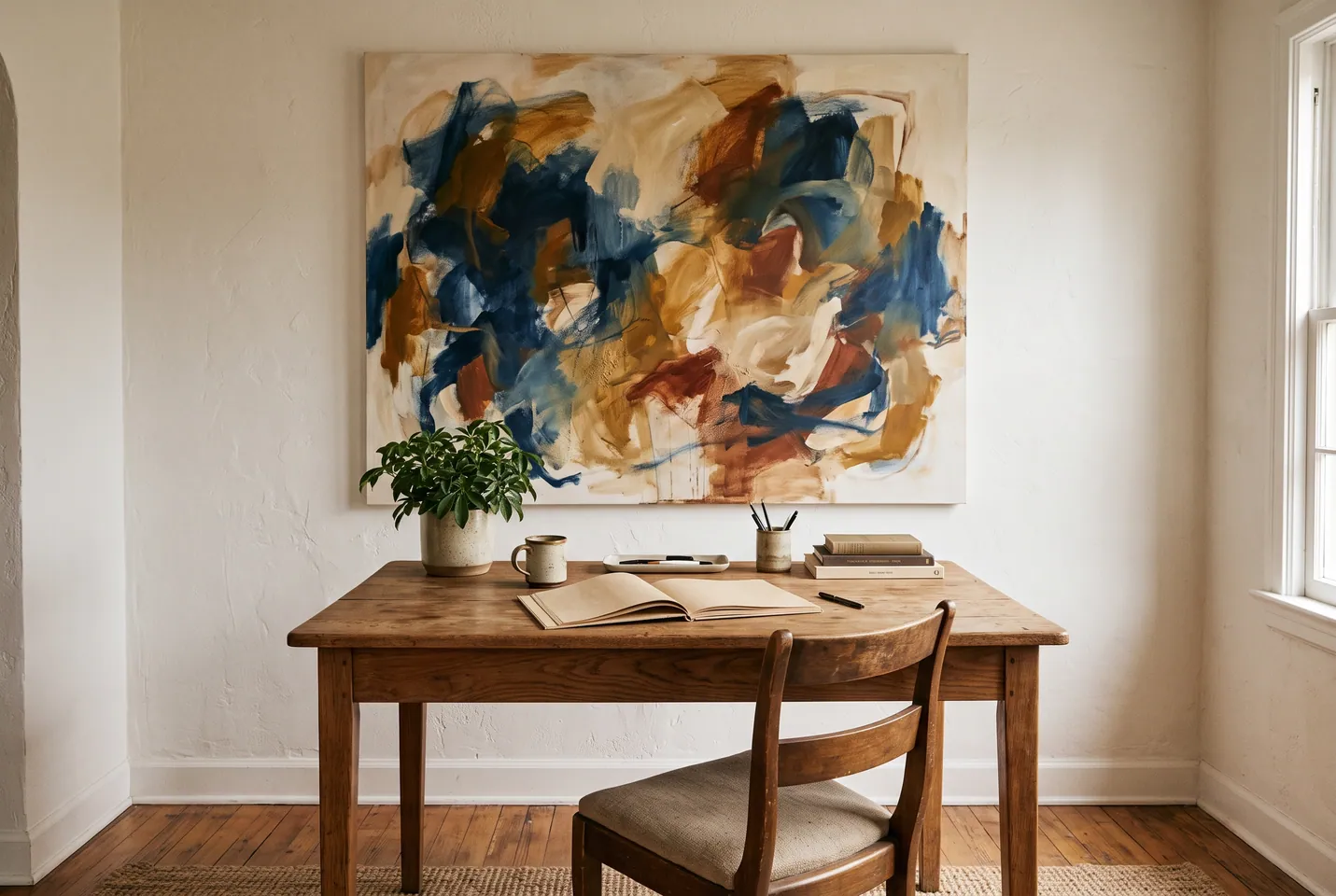
Good AI art prompts for canvas wall art say what belongs in the picture, how it should look, and how it should fit the wall. The 20 examples below are grouped by room and canvas shape: 1:1 square, 2:3 portrait, and 3:2 landscape. Treat them as starting points, then change the subject, palette, or mood to suit your room.
How do you build a useful art prompt?
Name the subject first, then add a style, a mood, a palette, and a composition. For canvas art, composition matters because a portrait layout needs a different arrangement from a wide landscape. Adobe's text-to-image prompt guidance and Google's Gemini image prompt guide both recommend describing the image you want with concrete visual details.
| Prompt element | Example words | What it tells the generator |
|---|---|---|
| Subject | olive branches in a ceramic vase | What should appear in the artwork |
| Style | loose watercolor, visible paper texture | How the marks and surfaces should look |
| Mood | quiet morning, soft and unhurried | The emotional tone of the scene |
| Palette | sage, warm cream, muted terracotta | Which colors should lead |
| Composition | centered vase, open space around it | Where the subject sits and how much room it has |
| Shape | square 1:1 composition | The outline the artwork should fit |
You do not need a paragraph of adjectives. “A vase of olive branches” gives the generator a subject; adding “loose watercolor, sage and cream, centered with open space” gives it a clearer visual direction. OpenAI's image prompting guide also recommends describing the subject, composition, style, and constraints.
Which prompts work for each room?
Use the room to choose a subject and mood, then match the prompt's shape to the wall space. Each idea below includes its suggested ratio. The ratios describe the artwork outline, not a guarantee about how a particular image generator will frame every detail.
Living room
- 1:1: Soft abstract shapes in warm cream, rust, and dusty rose, layered like cut paper, balanced center with calm open space.
- 3:2: A hazy coastline at late afternoon, muted blue and sand, painterly brushwork, low horizon with broad open sky.
- 2:3: Tall stems of wildflowers in a narrow glass vase, loose gouache, olive green and pale peach, stems reaching upward.
- 3:2: Rolling hills seen through morning mist, soft watercolor washes, sage and stone, distant ridgelines across a wide composition.
- 1:1: A simple still life of pears and a folded linen cloth, modern oil-paint texture, ochre and cream, arranged with space around each object.
Bedroom
- 2:3: A single branch with small blossoms against a warm ivory background, delicate ink and watercolor, quiet pale pinks, vertically balanced.
- 3:2: Moonlight over a calm lake, softened edges, deep blue-grey and silver, a low horizon and no bright focal point.
- 1:1: Abstract overlapping arcs in muted lavender, clay, and cream, matte painted texture, gentle movement with generous negative space.
- 2:3: A field of tall grasses in early morning light, impressionistic brushwork, soft green and wheat, vertical view with a distant sky.
- 3:2: A quiet garden path under leafy trees, dappled light, subdued greens, painterly detail and an inviting view into the distance.
Dining room and kitchen
- 1:1: Citrus branches with ripe lemons in a hand-thrown jug, textured gouache, lemon yellow and leaf green, simple centered still life.
- 3:2: A market table with figs, pears, and a striped cloth, warm loose oil painting, plum and ochre, arranged across a wide tabletop.
- 2:3: A tall stem of artichoke leaves in a ceramic vessel, botanical illustration with soft shading, olive and cream, clear silhouette.
- 1:1: Three pears on a blue-grey plate, modern still-life painting, muted yellow and slate, close composition with a plain background.
- 3:2: A sunlit herb garden viewed from above, loose watercolor, greens with small touches of terracotta, repeating leaf shapes across the frame.
Hallway or entryway
- 2:3: A narrow path through a stand of birch trees, simplified painterly forms, charcoal, cream, and moss, trunks rising vertically.
- 1:1: A small arrangement of wildflowers in a blue bottle, naive folk-art shapes, cobalt and butter yellow, centered against warm white.
- 3:2: Abstract horizon bands suggesting sea and sky, textured acrylic, faded blue and sand, long horizontal layers with no lettering.
- 2:3: A single architectural arch with a view of a garden beyond, soft Mediterranean palette, painted plaster texture, centered vertical framing.
- 1:1: A bowl of smooth river stones and a small branch, minimal ink-and-wash, warm grey and pale green, quiet balanced arrangement.
To make any prompt more personal, replace one detail at a time. Change the palette to match a rug or accent color, swap the flowers for a plant you like, or describe a softer or more energetic mood. For more room-specific ideas, browse living room canvas wall art ideas. You can also start creating through AI canvas prints or explore custom AI wall art.
How do you match the prompt to the canvas shape?
Put the intended shape in the prompt, then select the matching ratio in the generator. CanvasGenie offers Square (1:1), Portrait (2:3), and Landscape (3:2). Available print dimensions vary by product, so confirm the exact size in the canvas size guide before choosing.
| Ratio | Shape | Prompt cue | Common use |
|---|---|---|---|
| 1:1 | Square | “square composition, centered subject” | A compact wall area or one piece in a group |
| 2:3 | Portrait | “vertical composition, subject rising upward” | A narrow section of wall or a tall subject |
| 3:2 | Landscape | “wide composition, details spread horizontally” | A broad wall area or a wide scene |
The dimension order is width by height. A 24×36 inch canvas is portrait; a 36×24 inch canvas is landscape. For a deeper look at proportions, read AI art aspect ratios for canvas. For room placement and measurements, use the canvas size guide or read how to size a canvas above a couch.
What should you leave out of a prompt?
Remove instructions that compete with the main idea. A prompt asking for a calm bedroom scene with bright neon colors, dramatic action, and many tiny objects gives the generator several directions at once. Choose the detail that matters most and make the other choices support it.
Keep important subjects away from the edges when you want a print with breathing room. Be cautious with detailed lettering, since generated text may not match what you intended. If the result feels crowded, ask for fewer objects or more open background; if the colors feel wrong, change the palette while leaving the subject and composition in place. Google's guide describes refining image prompts by adding or changing visual details.
For a photo reference, describe the style and mood you want the new artwork to take from the image. CanvasGenie creates a painted interpretation from that reference, rather than printing the uploaded photo unchanged.
How can you revise a prompt without starting over?
Keep the subject and change one visual instruction at a time. OpenAI's image prompting guide describes iteration as a way to refine a result. For example, keep “a vase of olive branches” and adjust “muted sage and cream” to “deep green and warm ochre,” or change “centered” to “placed on the left with open space on the right.”
The generator accepts a written description of 10 to 500 characters. Start with the subject, style, palette, and shape, then trim details that do not help you picture the result.